NeurIPS 2026

UltraFlash: Accelerating Megapixel Visual Synthesis

Phuc Lai* · Anh Nguyen* · Phong Nguyen · Anh Tran

Qualcomm AI Research Qualcomm AI Research is an initiative of Qualcomm Technologies, Inc.  *Equal contribution.

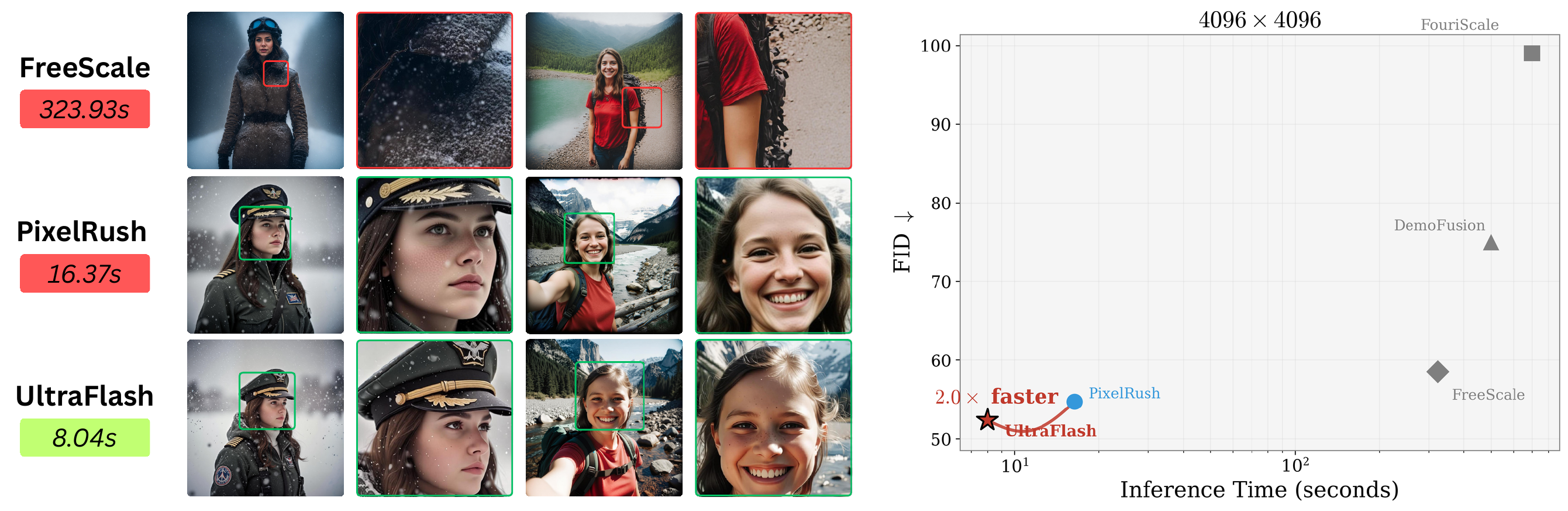
Side-by-side 4K crops and a speed-quality plot. UltraFlash generates 4096 images in 8.04 seconds with lower FID than PixelRush, FreeScale, DemoFusion, and FouriScale.
4K images in about 8 seconds. UltraFlash reaches 8.04s with better FID than PixelRush at 16.37s, and about 40× faster than FreeScale at 323.93s. Click to zoom.

Abstract

Megapixel visual synthesis with latent diffusion models requires operating far beyond the resolution at which these models are trained. Cascade refinement is the most successful approach to handling this problem: it upgrades a base image at a regular resolution to the target resolution via multiple cascade upsampling steps, each involving a resolution upgrade traversed through pixel space and a denoising-based refinement in latent space. Although denoising is often treated as the main cost, we identify an underexplored source of overhead: repeatedly moving representations through the VAE. We refer to these steps as pixel-space transitions: intermediate latents are decoded to RGB, resized, and re-encoded before refinement, while final latents are decoded patch by patch with dense overlap to suppress artifacts. We present UltraFlash, which shifts the focus of acceleration from denoising alone to the VAE transitions around it. Its first component, Latent Hyperloop, replaces the intermediate RGB round trip with a learned latent-space shortcut that approximates the same transformation while avoiding repeated VAE calls for decoding and encoding. Its second component, Sparse Patch-based Decoding, makes final reconstruction efficient by tracing patch seams to inconsistent GroupNorm statistics and reusing cached statistics across patches, enabling sparse VAE decoding with much smaller overlap. Integrated into the current state-of-the-art baseline, UltraFlash reduces 4K generation latency by ∼2× while improving image quality, demonstrating that transition-level optimization can advance both efficiency and fidelity. More broadly, these transition costs recur across megapixel synthesis pipelines, suggesting that optimizing pixel-space transitions is an effective route to fast, high-fidelity visual synthesis.

Method

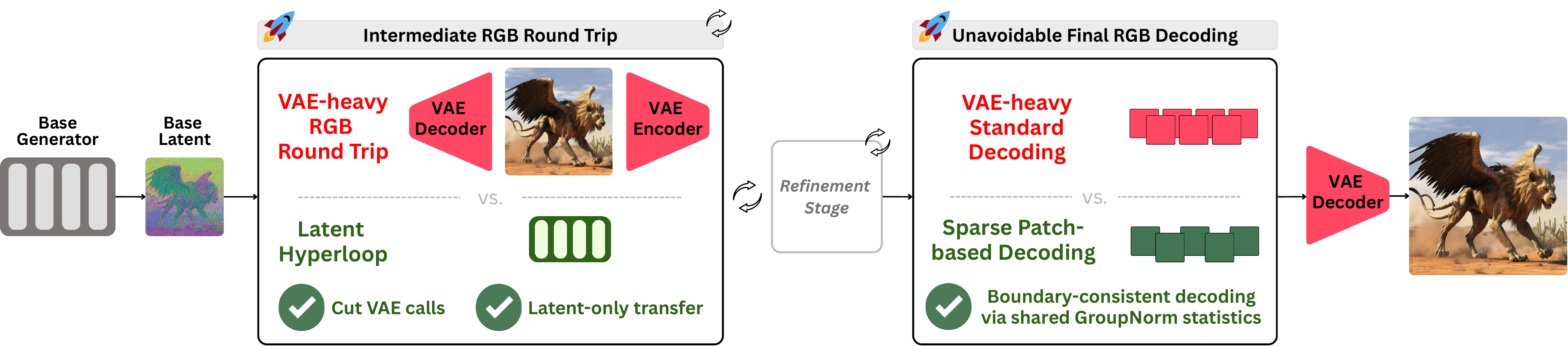
Two operators cover the two VAE transitions in a cascade, and the denoiser is left unchanged. In our main instantiation the intermediate round trip is about 30–40% of cascade-stage runtime.

UltraFlash pipeline. Latent Hyperloop replaces the intermediate VAE decode-resize-encode round trip. Sparse Patch-based Decoding replaces dense final VAE decoding with boundary-consistent sparse patches.
Cascade pipelines use pixel space twice: an intermediate RGB round trip, then a dense final decode. Click a step, or the figure to zoom.

Many cascades initialize each refinement stage with the pixel-space operator \(\mathrm{UP}_{\mathrm{pixel}}\):

\[\bar{\mathbf{z}}_0^{4r}=\mathrm{UP}_{\mathrm{pixel}}(\mathbf{z}_0^r)=\mathcal{E}\!\left(\mathrm{Interpolate}(\mathcal{D}(\mathbf{z}_0^r),2)\right).\]

Latent interpolation is not a substitute. The VAE encoder is nonlinear, so

\[\mathrm{Interpolate}(\mathbf{z},2)\neq\mathrm{UP}_{\mathrm{pixel}}(\mathbf{z}).\]

Latent Hyperloop is a lightweight function \(\mathcal{H}_{\phi}\), about 5M trainable parameters, that predicts the latent that round trip would have produced:

\[\bar{\mathbf{z}}_0^{4r}=\mathcal{H}_{\phi}(\mathbf{z}_0^r)\approx\mathrm{UP}_{\mathrm{pixel}}(\mathbf{z}_0^r).\]

It reuses the frozen first decoder block \(\mathcal{D}^{(1)}\) as a spatial prior. A projection head \(h_{\psi}\) fixes the channel count and the geometry, so \(\mathcal{H}_{\phi}\) is \(\mathcal{D}^{(1)}\) followed by \(h_{\psi}\).

Each 64-pixel source crop is padded with 8 pixels of context on every side, so an \(80\times80\) input predicts a \(128\times128\) patch. Training uses an \(\ell_1\) reconstruction loss and an attention-alignment loss that matches the refiner’s self-attention maps, combined with equal weights. Because the pairs come from encoded images rather than an imperfect VAE round trip, the shortcut can beat the trip it replaces.
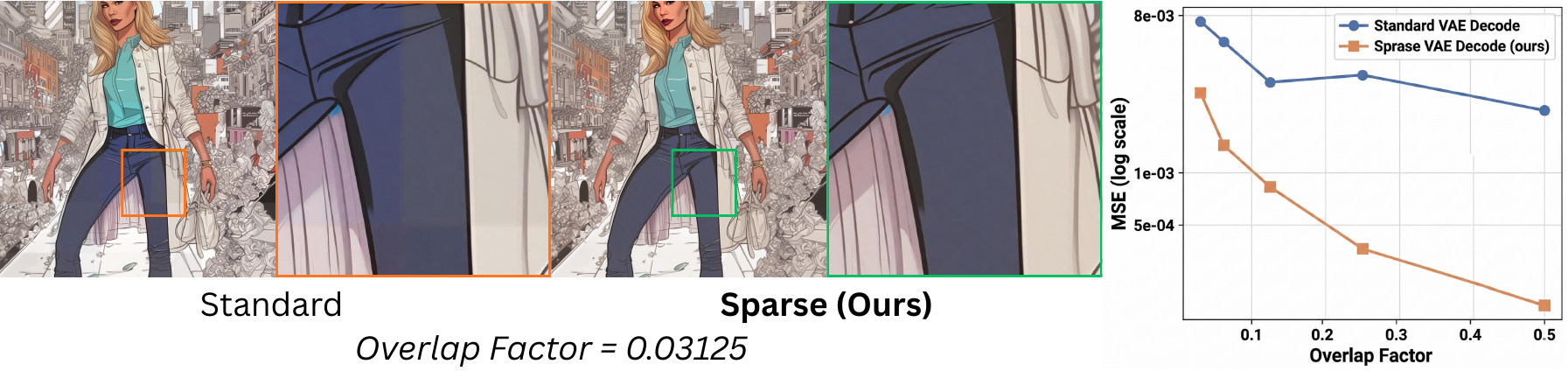
The last transition cannot be skipped: the output has to be RGB. At megapixel scale the full latent often does not fit in memory, so pipelines decode overlapping patches and blend them. A 25% overlap is common because each patch computes its own GroupNorm mean and variance, and the same latent values then decode to different pixels. The blend is what hides the seam.

Sparse Patch-based Decoding computes those statistics once, from the four corner patches, and reuses them at every GroupNorm layer. Overlaps then agree, so the overlap can shrink from 25% to 3.125% — an 8× reduction — with no extra training. Shared statistics are used only for this final decode. Latent Hyperloop still emits overlapping latent patches, and the next refinement stage blends those.

At overlap 0.03125, standard patch decoding shows a seam while sparse decoding with shared GroupNorm statistics stays continuous. A plot shows lower boundary MSE for the sparse decoder across overlap factors.

Speed

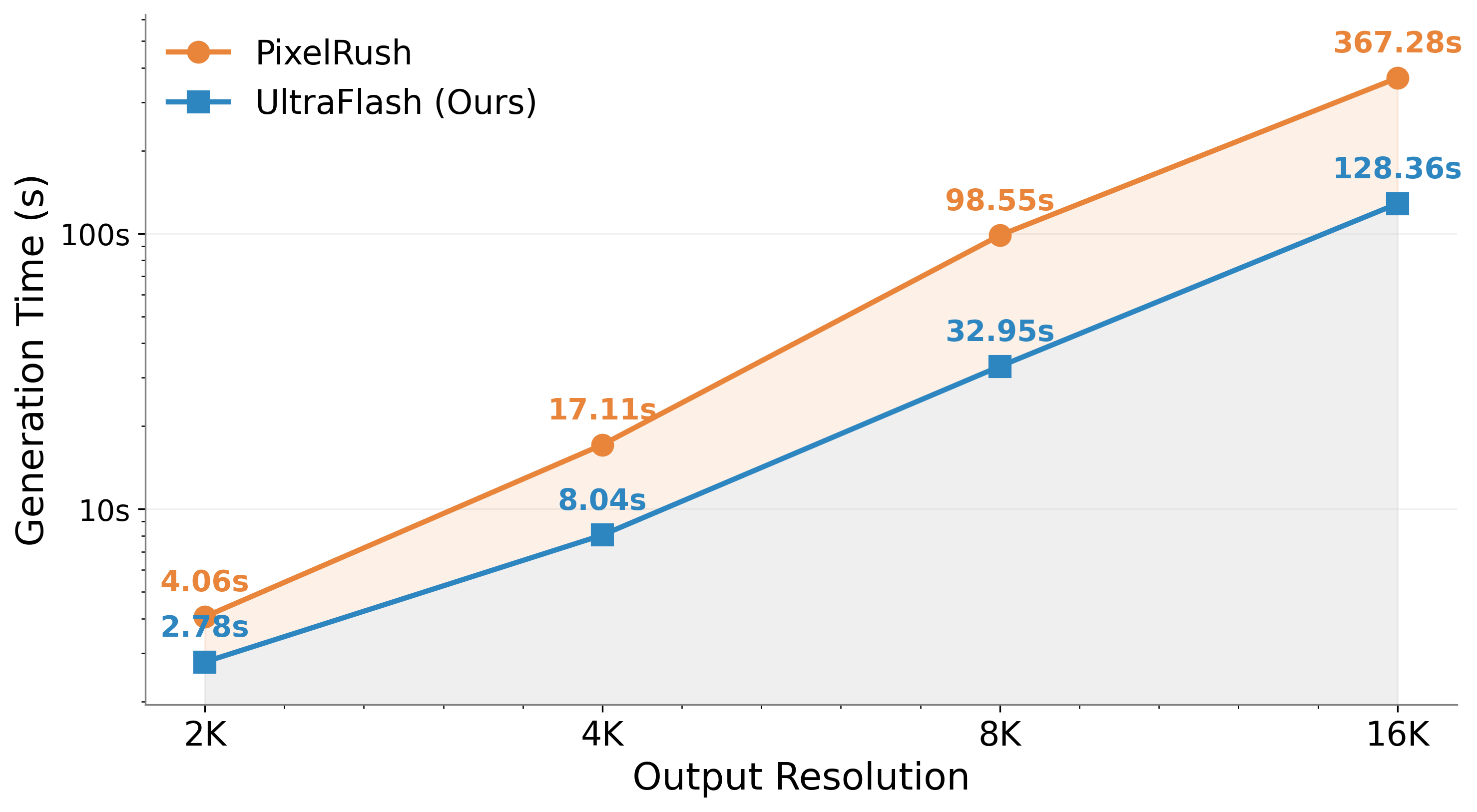
The same 2× Latent Hyperloop step is reused at every cascade level, so 8K and 16K do not need a new model. The gap over PixelRush widens as the canvas grows. Times are on one A100 40GB.

4K: UltraFlash 8.04s, PixelRush 17.11s.

Log-scale generation time from 2K to 16K. UltraFlash is 2.78s, 8.04s, 32.95s, and 128.36s. PixelRush is 4.06s, 17.11s, 98.55s, and 367.28s.
Inference latency from 2K to 16K. At 4K, UltraFlash is 8.04s against PixelRush at 17.11s; at 16K, 128s against 367s. Click to zoom.

Qualitative Comparison

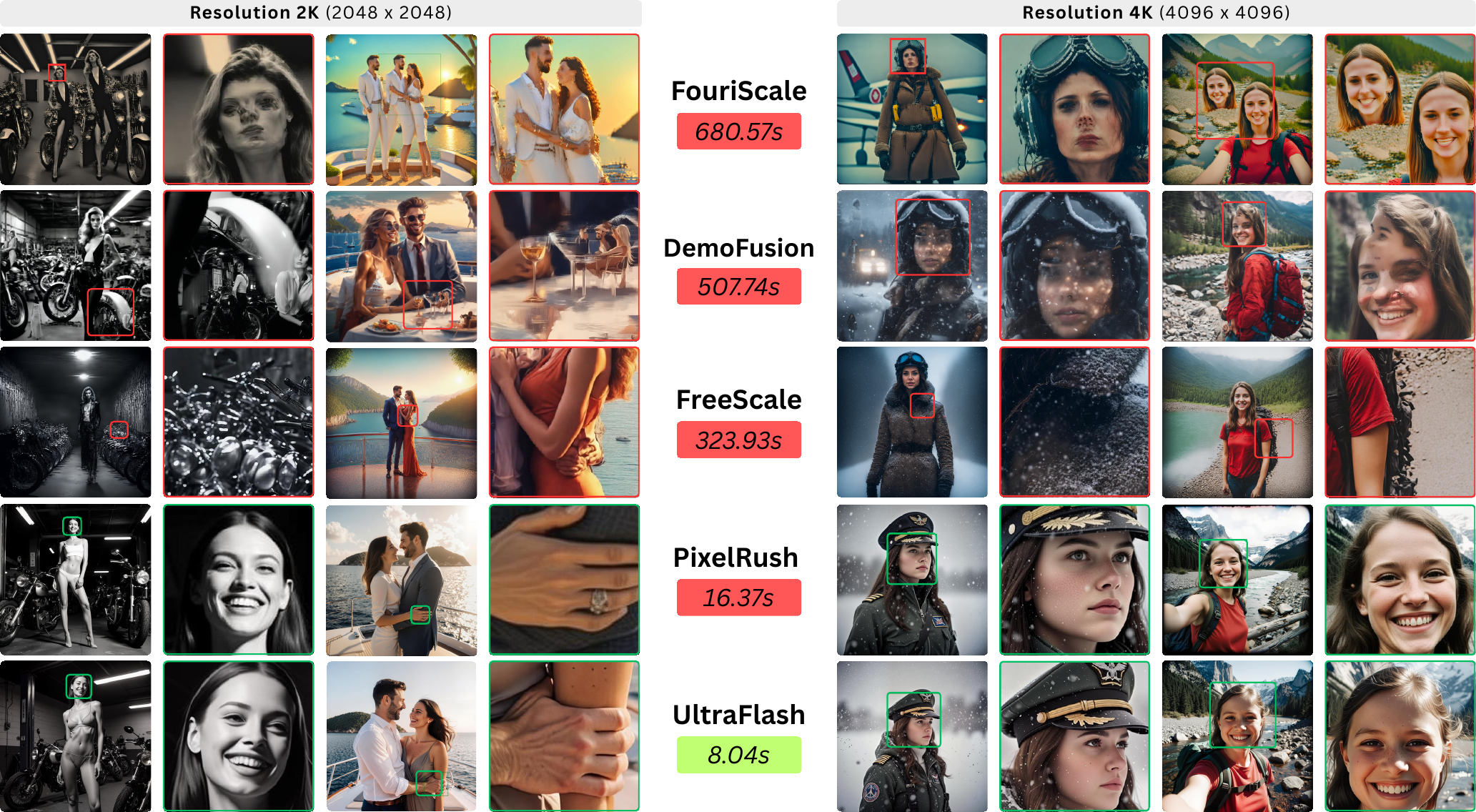
At 2K and 4K, UltraFlash keeps the global layout of the fast cascade and restores sharper textures than PixelRush. FouriScale, DemoFusion, and FreeScale show repetition, broken structure, or heavy high-frequency noise, and they take minutes at 4K.

Qualitative comparison at 2048 and 4096. FouriScale 680.57s, DemoFusion 507.74s, FreeScale 323.93s, PixelRush 16.37s, UltraFlash 8.04s. UltraFlash crops are sharper on faces, fabric, and fine structure.
Left: 2048×2048. Right: 4096×4096. Runtimes on the right are at 4K. Click to zoom.

More 4K samples

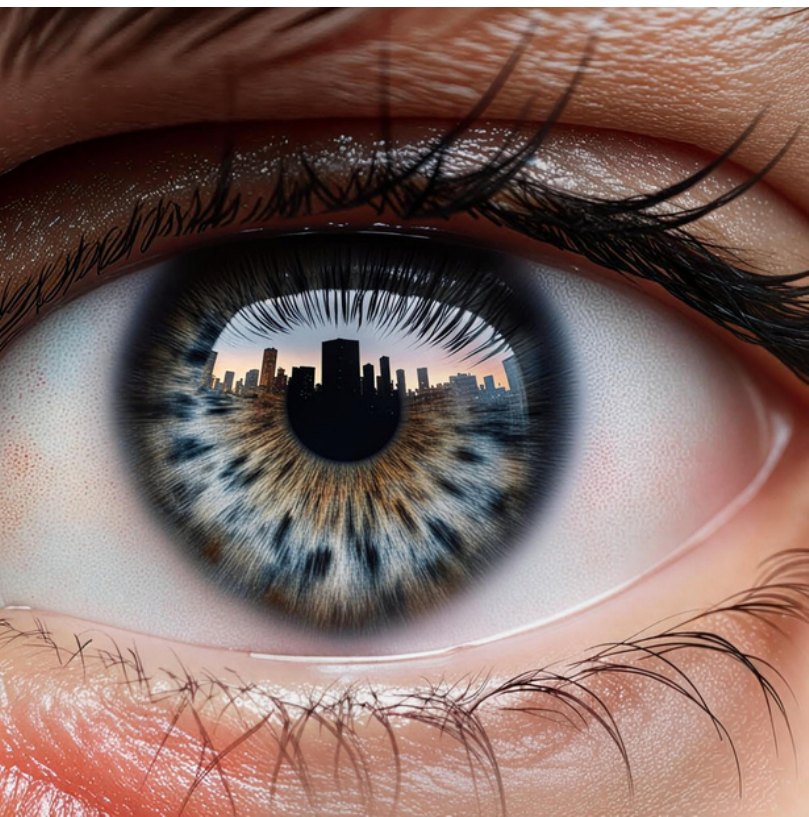
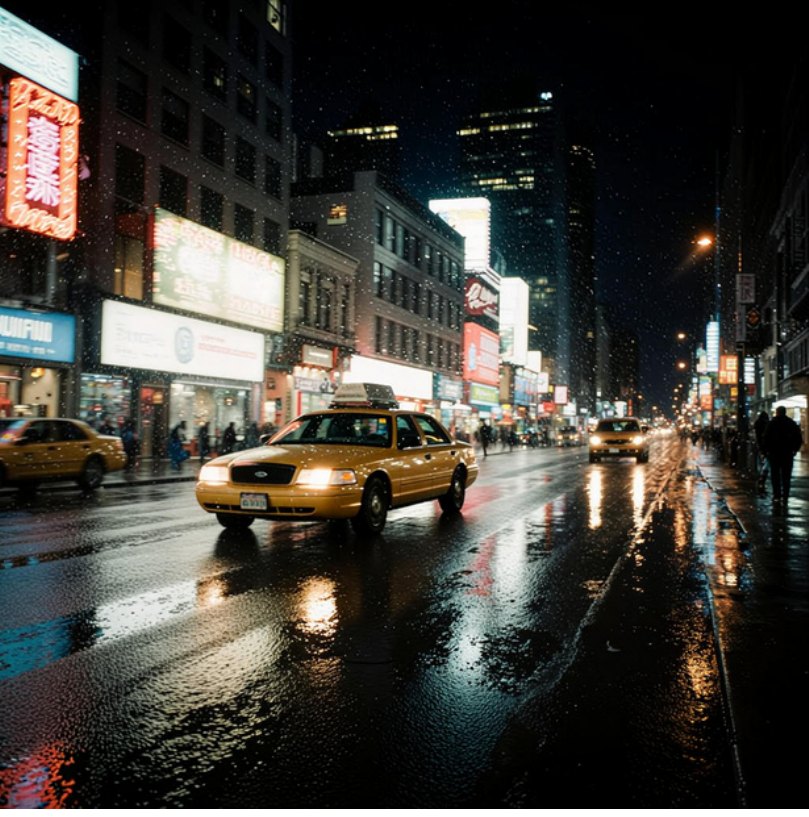
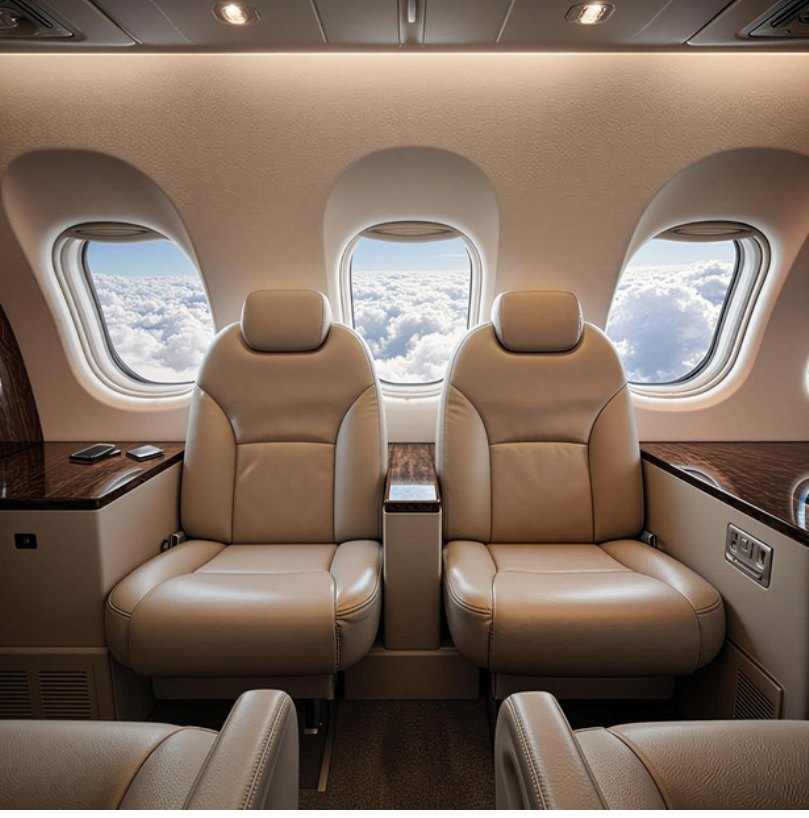
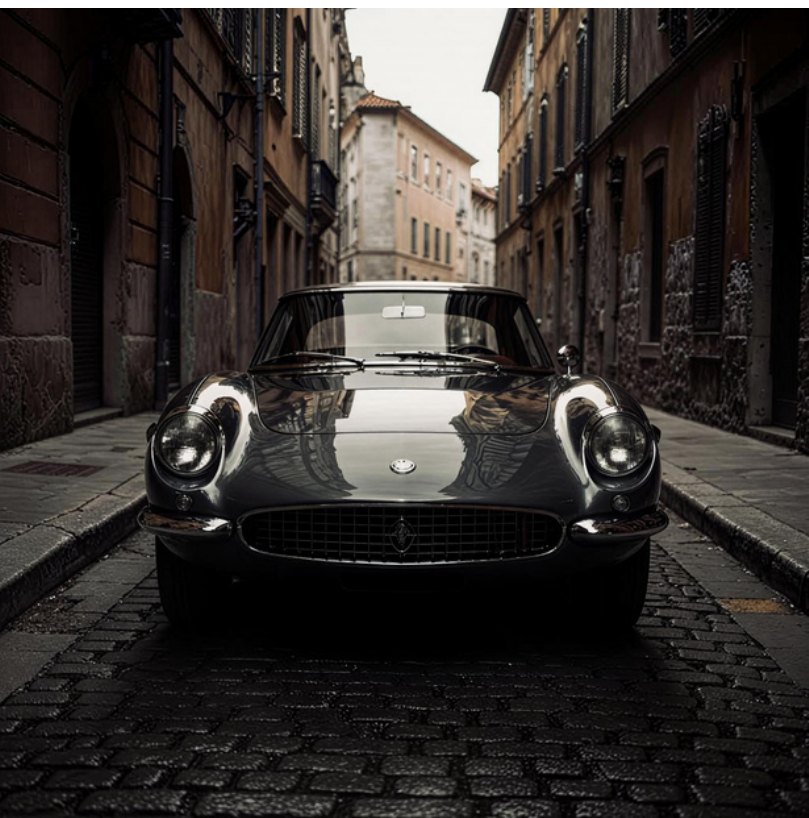
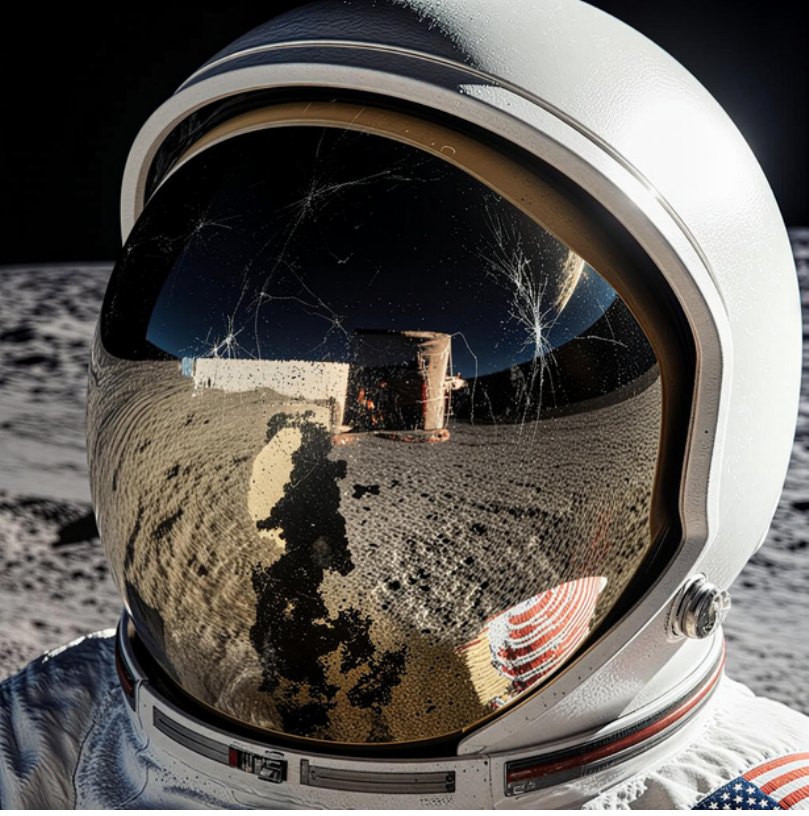
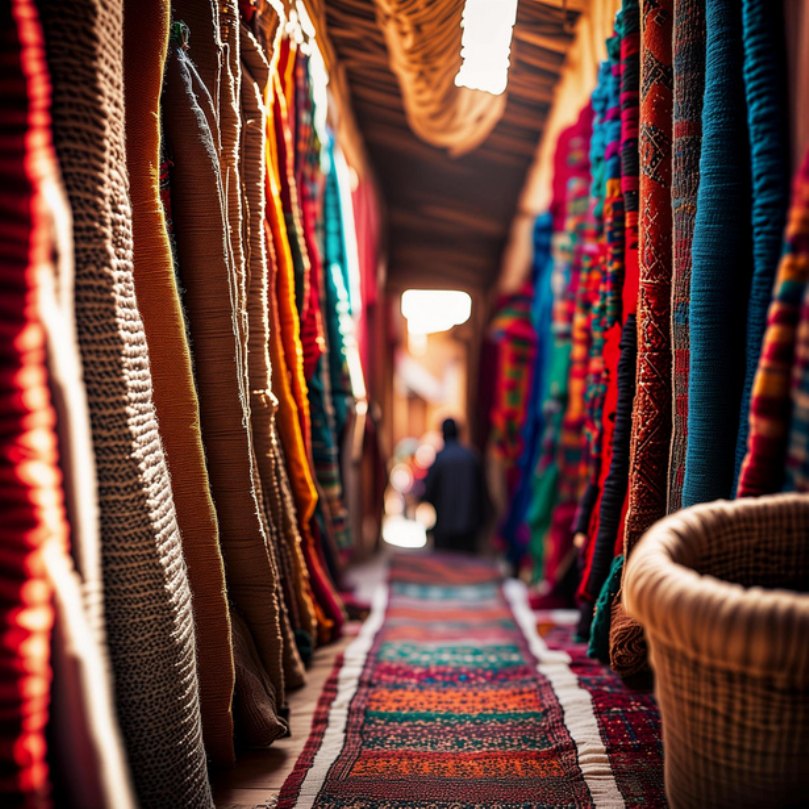
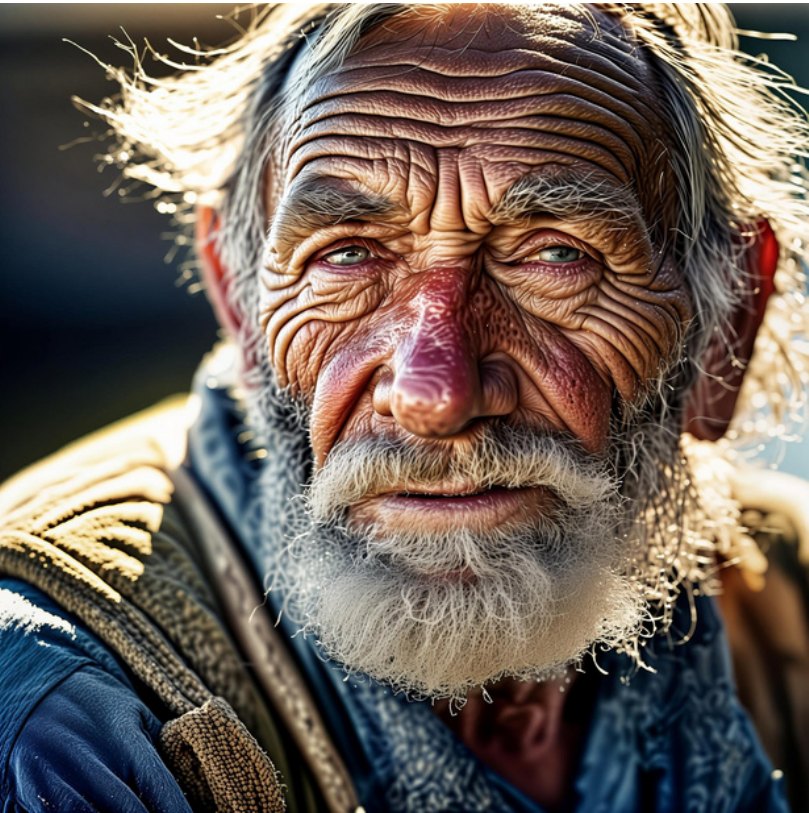
Uncurated 4096×4096 outputs from the same UltraFlash pipeline on FLUX and SDXL. Click an image to zoom.

Quantitative Results

1,000 prompts from LAION-Aesthetics. FID measures global quality, FIDc is crop-based local texture, and IS is Inception Score. Bold is best and underline is second in each column. Hover a row for context. All times are on one A100 40GB.

Method FID ↓ FIDc ↓ IS ↑ Time (s) ↓
FouriScale 72.65 51.90 12.31 87.84
DemoFusion 68.46 43.39 13.15 75.89
FreeScale 52.87 29.64 13.56 53.20
PixelRush-SD 52.56 29.66 13.69 3.17
PixelRush-XL 50.13 29.13 14.32 4.06
UltraFlash-SD 50.02 29.21 14.03 2.78
UltraFlash-XL 49.86 29.73 14.14 3.50

Method FID ↓ FIDc ↓ IS ↑ Time (s) ↓
FouriScale 98.97 69.56 8.54 680.57
DemoFusion 74.75 52.14 12.57 507.74
FreeScale 58.28 34.01 13.35 323.93
PixelRush-SD 56.50 33.76 13.42 16.37
PixelRush-XL 54.28 33.15 13.71 17.11
UltraFlash-SD 52.38 32.47 13.99 8.04
UltraFlash-XL 51.32 33.01 13.93 9.61

Other 4K routes

Different backbones, so this is context rather than a matched comparison. UltraFlash-SD is faster than native SANA-4K and direct FLUX extrapolation, with a lower FID.

Method Route FID ↓ Time (s) ↓
SANA-4K Native 4K 72.13 24.79
DyPE-FLUX Direct 4K 59.05 587.13
UltraFlash-SD Cascade 52.38 8.04
UltraFlash-XL Cascade 51.32 9.61

Plug-in on FreeScale

The same operators transfer. FreeScale stays dominated by multi-step denoising, so the runtime change is small and the FID gain remains.

FID ↓ FIDc ↓ IS ↑ Time (s)
FreeScale 58.28 34.01 13.35 323.93
+ UltraFlash 54.42 34.58 13.66 313.40

User Study

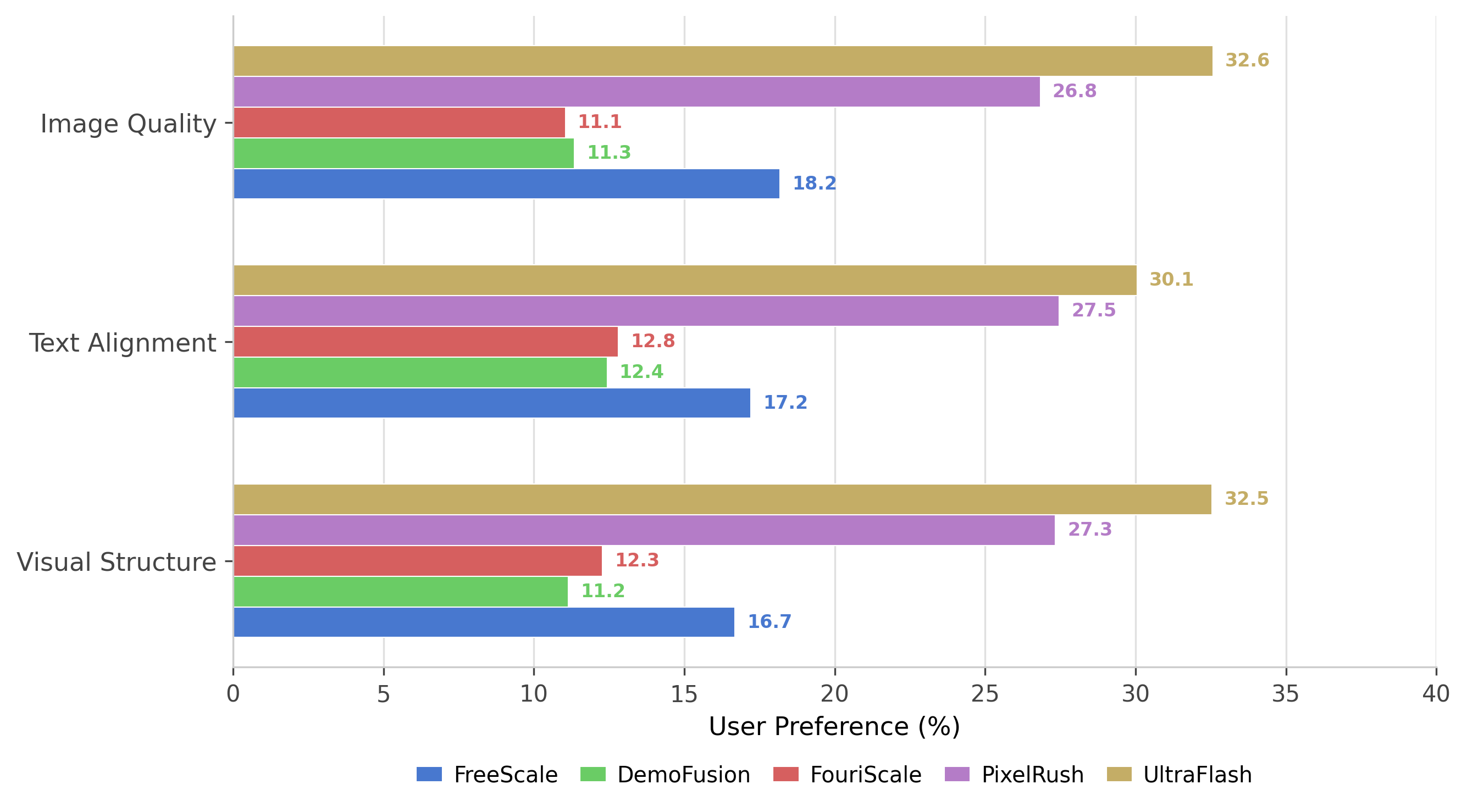
137 participants compared UltraFlash with FouriScale, DemoFusion, FreeScale, and PixelRush on 25 prompts, for 3,425 comparisons. UltraFlash receives the highest share on every criterion, about 30–33%.

30.1%Text alignment
32.6%Image quality
32.5%Visual structure
Horizontal bar chart of user preference. UltraFlash leads image quality at 32.6 percent, text alignment at 30.1 percent, and visual structure at 32.5 percent.
Preference share by criterion. Gold bars are UltraFlash. Participants favor its sharp textures and coherent structure over tiling and repetition in the other methods.

BibTeX

@inproceedings{lai2026ultraflash,
  title     = {UltraFlash: Accelerating Megapixel Visual Synthesis},
  author    = {Lai, Phuc and Nguyen, Anh and Nguyen, Phong and Tran, Anh},
  booktitle = {Advances in Neural Information Processing Systems},
  year      = {2026}
}